
Lauderdale's Owner-of-Record Card
The county-linked DCS appraisal record packs the current assessment identity into one compact card. Read the labels literally. The word OWNER names the party on that tax record. Its neighboring fields tell you whether the card matches the parcel you want and whether a newer transfer deserves a look.
| OWNER | Person or entity carried on the assessment record |
|---|---|
| Mailing Address | Destination for owner correspondence, not proof of occupancy |
| ADDRESS / PROPERTY ADDRESS | Situs assigned to the parcel |
| PPIN and PARCEL | Separate tax identifiers used to match the land |
| LAST DEED DATE | Date clue supplied on the appraisal card |
| BOOK and PAGE | Reference that can point to a recorded instrument |
The card does not prove occupancy. Nor does it promise that no later deed exists. Until you check the latest recorded conveyance, report the result as the owner shown on the tax record.
Read Lauderdale's Current Owner Fields
The appraisal detail record lists the owner name beside the parcel, PPIN, tax district, deed book and page, previous owner, last deed date, legal description, and property address. That one card answers many questions at once.
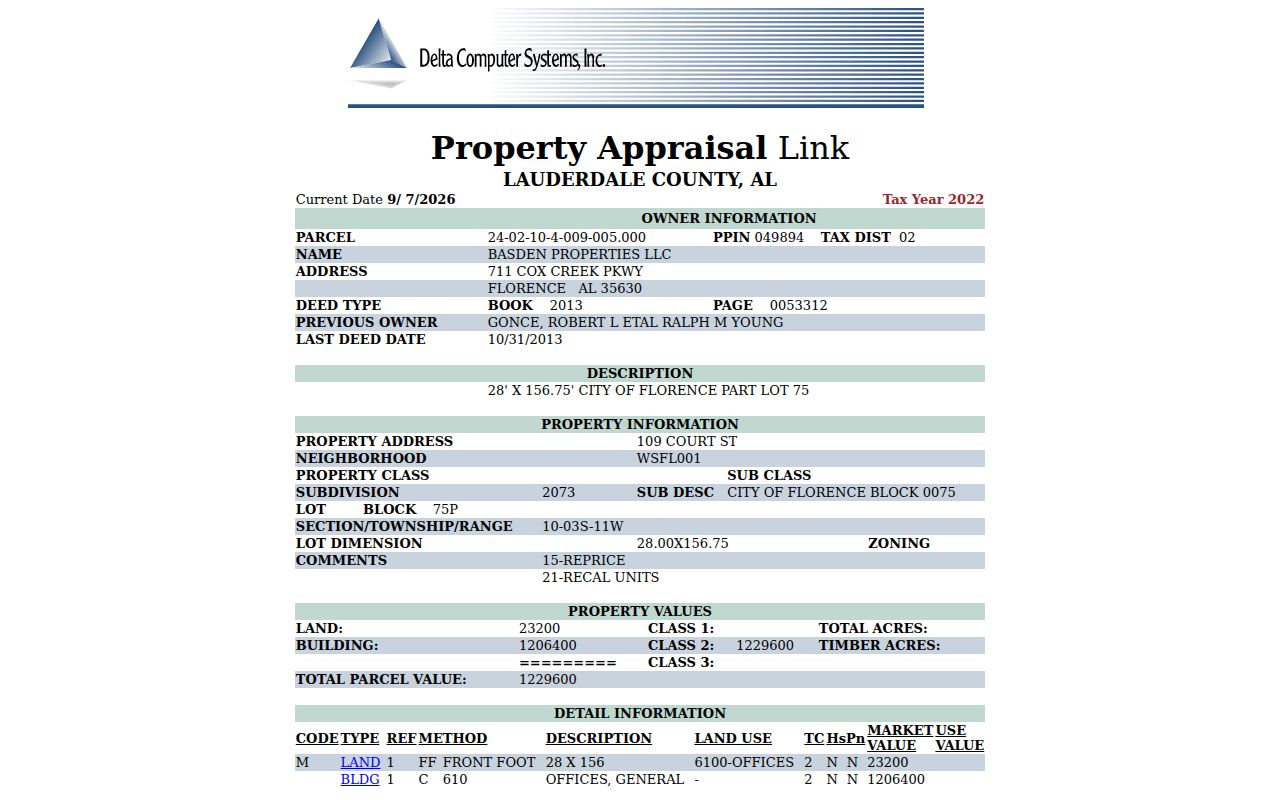
The example is a reading model. It is not proof of a private transaction. Its sample book and page show how the assessment roll can point you to Probate for the instrument behind the current owner entry.
Check Lauderdale Owner Record Freshness
Every current-owner answer needs a date attached. The DCS Lauderdale portal posts a Records Last Updated banner on each result. The portal also warns that uploaded records can lag actual courthouse activity. No fixed refresh cycle is published. Open the DCS Lauderdale portal and read the banner. Then note the date of your own search. A date you saw once is not today's date. If a closing, an estate, or a court transfer could be newer, the assessment name needs a deed check. Do that before you rely on it.
Recent-sale gap. The roll can trail a recorded sale. A newer verified deed is the stronger current-owner record.
Confirm Lauderdale's Current Owner
Verification runs from the assessment card to the newest instrument recorded against the same land. A street name alone is not enough. The PPIN, full parcel number, legal description, and the card's book and page clue keep you from landing on a similarly named party or an adjoining tract. Match those before you trust the name.
- Record the exact OWNER label, PPIN, parcel, situs, and legal-description text from DCS.
- Open the county-linked Ingenuity landing page in a normal browser and choose land records, or contact Lauderdale Recording at 256-760-5800.
- Locate the newest deed for the matching legal description. Compare recording date, grantor, grantee, and book/page.
- If that deed postdates the assessment source, report its grantee as the newer transfer finding and retain both dates.
Online coverage dates are not published. Neither are the full search fields. In-person research remains available at the Lauderdale County Courthouse, 200 South Court Street in Florence, during posted weekday hours. A written request can include the owner name, PPIN, parcel, and any known book and page.
Current Lauderdale Owner Terms
Several owner labels sound alike yet answer different questions. Keeping them straight stops a Lauderdale County property owner result from turning into an unsupported claim.
- Owner of record
- The party named on the record being consulted, such as the assessment roll.
- Assessment roll
- The county record used to assess land and improvements for property tax purposes.
- Situs
- The property location, which can differ from the owner’s mailing address.
- Recording lag
- The time between a transfer and its appearance in another system.
- Grantee
- The party receiving the interest described by a deed.
Vesting describes how an interest is held. The DCS label alone does not settle every title condition, so read the actual deed for the granted interest and any stated co-ownership terms.
Separate Lauderdale Owner Addresses
The owner's mailing address is an administrative contact field. The situs marks where the parcel physically sits. The two often differ in Lauderdale County. One tax card sends correspondence to a Florence post-office box. The parcel itself sits on Court Street. Another appraisal example pairs a Cox Creek Parkway mailing address with a different Court Street property address.
Neither pattern tells you who occupies the building. A business routes mail to an office; an individual may prefer a post-office box. Owners can also hold more than one Lauderdale County parcel. For a lawful property inquiry, address mail to the owner name. Use the name exactly as printed on the current tax record. Avoid publishing more personal data than the boundary or transaction question requires.
Note: A Florence postal city or ZIP does not establish City of Florence jurisdiction by itself.
Verify Lauderdale Entity Ownership
An LLC or corporation in the owner field calls for one more step. Use the Alabama Secretary of State entity search to confirm the precise registered name and separate similar entities. Search options run by name, number, or officer.
An agent is not the parcel owner. An officer's address does not prove control. The deed and the assessment may vest the parcel in the business itself. Trust and estate names deserve the same care. Probate case records can explain a transfer, but the instrument or final order tied to the legal description remains the key property evidence.
The Lauderdale Probate Court page gives the courthouse route and current office contacts for estate matters. It complements the card. It never replaces the current deed check.
Match Lauderdale's Current Parcel
An owner lookup can still come back wrong even when the name is plainly readable. Splits, mergers, address changes, and duplicate accounts all conspire to point you at the wrong piece of land. Lauderdale's DCS system wants the full parcel format, all eight components, leading zeroes and the decimal segment included. It also runs on a separate six-digit PPIN. Keep both handy.
Then check the legal description against what you found. Lauderdale records carry block, subdivision, lot dimension, section-township-range, and deed book and page. One appraisal card listed City of Florence Block 0075, block 75P, section 10-03S-11W, and book 2013/page 0053312. A separate tax detail described the same general spot as City of Florence part of Block 75, PB 2 PG 155. Matching street addresses alone do not make those two records interchangeable.
When the number and the description disagree, call mapping at 256-760-5782 before you name a current owner. Mapping handles the tax-map identity question. Probate answers the deed question. A survey settles physical boundaries. Keeping those roles straight stops an apparent owner mismatch from being quietly fixed by picking whichever system says what you expect.
Report Lauderdale's Current Owner Carefully
A careful result names its label, source, and date. Saying “DCS listed X as OWNER when checked on [date]” beats a bare claim that X owns the parcel. That phrasing shows the label, the source, and the date. If Probate shows a later deed, give its recording date and grantee. Then explain that it postdates the assessment record.
Use the current tax mailing address only for a real parcel matter. A proposed purchase, easement question, boundary concern, or estate inquiry all qualify. Never infer residence from it. Do not use owner information to harass, intimidate, impersonate, or target anyone.
For the wider address-to-owner approach, see who owns this property. For ownership history, turn to former owners. That is a separate process. It reads the deed chain backward. Recording and copy requirements for one deed belong with Lauderdale deed records.
When the online owner card is unavailable, Revenue answers directly. Call assessment at 256-760-5785, appraisal at 256-760-5780, or mapping at 256-760-5782. Mail goes to P.O. Box 794, Florence, AL 35631, and the courthouse offers the in-person route. Include the PPIN, parcel, situs, and the fields you need. For a deed comparison, contact Recording on its own. That keeps each piece of the current-owner check with the office that maintains it.
Date every answer you save. Note the live roll banner. Note the day the assessment card was opened. Note the recording date of the newest deed checked. Note the date Probate staff replied. When records disagree, keep both versions rather than quietly dropping one. The assessment name still serves tax administration. But the later recorded grantee may be the stronger evidence of a fresh transfer.