
Reconstruct Lauderdale's Former Owners
A Lauderdale ownership chain grows one grantor at a time. It always runs backward from a single verified transfer. The county appraisal card often helps. It can list a previous owner, a last deed date, and a book/page clue. Those are only leads. Every cited deed still has to match the legal description at the Probate Recording Department.
| Transfer Date | Grantor → Grantee | Deed Type | Book/Page |
|---|---|---|---|
| Newest verified date | Prior owner → current grantee | As recorded | Current reference |
| Earlier date | Earlier owner → prior owner | As recorded | Prior reference |
| Repeat backward | Earlier grantor → later grantee | Preserve exact type | Keep book/page together |
The worksheet shows sequence only. It is not a sample chain for a real parcel, so copy execution and recording dates from each instrument and never treat an appraisal comment as a transfer event.
Start with Lauderdale's Prior-Owner Field
A Lauderdale appraisal card holds four prior-owner clues. The detail lists PREVIOUS OWNER, LAST DEED DATE, BOOK, and PAGE, alongside parcel, PPIN, block, subdivision, lot dimensions, and section-township-range. None of it shows the full chain. Every field simply points toward the next recorded instrument. The county-linked Ingenuity landing page provides the public route to look up Lauderdale land records.
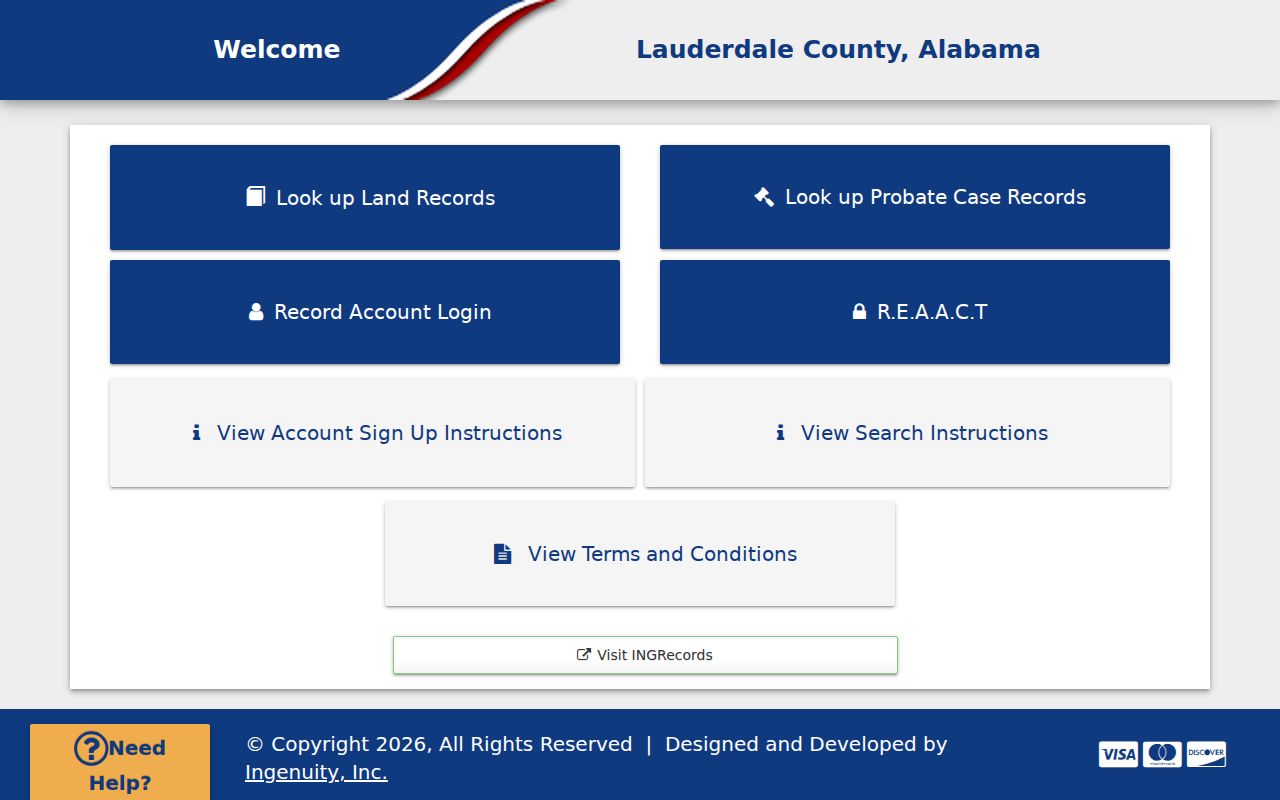
The entry point is a doorway. It is not a deed-index result. Use the appraisal clue in a manual search, follow the service terms, and verify the prior name and book/page against the recorded instrument.
Go Back Through Lauderdale Deeds
The Lauderdale County Judge of Probate records deeds. The county-linked Ingenuity service offers a land-record entry point, and the Recording staff handles deeper requests. Use the service manually under its own terms.
- Locate the newest verified deed and copy its legal description, grantor, grantee, recording date, and book/page.
- Use that grantor as the next backward name lead. Find the earlier instrument in which that party was the grantee.
- Compare property descriptions. A matching surname is not enough, and a parcel number may change after a split or merger.
- Repeat until the available index ends. Continue through county deed books, state land records, or archives as the era requires.
- Grantor
- The party conveying the interest described by an instrument.
- Grantee
- The party receiving that interest.
- Chain of title
- The ordered sequence of documents affecting ownership.
- Reverse index
- An index used to locate parties from the grantor side.
- Warranty and quitclaim
- Different deed forms whose effect must be read from the document.
Hold Lauderdale Land Descriptions Steady
Keep the land steady. The legal description must never drift. Copy lot, block, subdivision, metes-and-bounds calls, acreage, plat book/page, section-township-range, easements, reservations, and exceptions exactly as written. Compare every change with the prior deed and plat.
One Lauderdale sample preserves City of Florence Block 0075, block 75P, dimensions of 28 by 156.75 feet, section 10-03S-11W, and book 2013/page 0053312. A Court Street detail adds PB 2 PG 155 and a Tennessee Street/Court Street intersection call. Such clues outlive address changes and separate nearby tracts.
Note: PPIN and parcel link records together, but neither replaces the deed's legal description.
Reconcile Lauderdale Plat Changes
Street and subdivision history explains a lot. Lauderdale County Commission minutes from July 10, 2023 name Belle Meade Addition No. 1, Map Book 3 Page 166, Dalewood Street, and an alley or road vacation action.
The minutes are a lead. They are not proof that a specific title changed. Pull the underlying plat, the deed descriptions, and the current county map, then compare all three. A street action can reshape modern context. The original block and lot language still governs the past conveyances.
Extend Lauderdale Ownership Before 1950
The Alabama Secretary of State Lands Division says state land records run from statehood through 1950 and directs later county transactions to the Probate Judge. A long Lauderdale chain can cross two custodians. Search the state land portal and Alabama Department of Archives and History for early records, then bridge into county deeds.
No complete year range for Lauderdale's online deed index was verified. Do not invent a cutoff. The fallback is the Recording Department at 200 South Court Street, Florence, phone 256-760-5800, plus written requests carrying known names, description, and book/page clues.
Online time-depth limit. The earliest searchable deed year was not published. Older prior owners may require deed books, microfilm, and archives.
Use Lauderdale History as Leads
History rooms reward patient researchers. The Florence-Lauderdale Public Library Local History Room holds books, extensive microfilm, and local research tools. Its finding aid lists Lauderdale will-record microfilm covering parts of 1821 through 1929, plus two rolls of unrecorded estate packets. Probate papers explain inheritance and chain breaks.
The newspaper indexes run deep. They span several Florence Times, Florence Herald, and Times Daily ranges, and a directory or obituary can tie a name to an address. Spelling variants surface there too. None of it proves title. Confirm every lead through a deed index, a probate packet, or an official land record.
Call Local History staff at 256-764-6564, extension 130. Visit at 350 North Wood Avenue in Florence during posted hours, and ask staff about reverse directories before relying on that collection.
Continue Lauderdale Research Offline
Online indexing is not the only route. Lauderdale Recording supports in-person research at the courthouse and answers phone questions at 256-760-5800. A written request works best when it names grantor and grantee variants, the approximate date, instrument type, legal description, and any known book and page. Recording originals is a different errand. The county then demands correct payment, legible exhibits, a return person or company, and clean originals with no highlighting.
A return company is not an owner. Neither is a preparer or a notary. Return addresses, tax mailing data, and indexed parties are separate administrative facts in Lauderdale County property records, and each role deserves its printed label. Logging names under the wrong role is how phantom owners creep into a chain.
Certified copies run the published certification charge plus a per-page amount, though copy-order details belong on the deed page. Request only what closes a gap in the chain. Cite the office response for whatever arrives. When Lauderdale books end for the period in question, turn to the SOS Lands Division and state archives instead of assuming no older record exists.
State Lauderdale Ownership Limits
Several events can break a line of former owners. Estate transfers, name changes, corporate names, and altered descriptions all interrupt the sequence. Lauderdale recording even charges extra for indexed variants such as AKA, FKA, KNA, and WTTA. Keep every name form you encounter. Search each variant before concluding two spellings are different parties.
Some chains stop at an estate rather than a sale. Lauderdale Probate Court holds wills, administrations, guardianships, and conservatorships, and its case files may name heirs, representatives, inventories, or orders explaining why a later deed used different parties. The court sits at 200 South Court Street, answers 256-760-5804, and keeps weekday hours from 8:00 a.m. to 5:00 p.m. A written inquiry should give the estate name, the approximate period, and the land reference already found.
Estate papers open doors. A will alone, though, never proves a parcel actually transferred. Hunt for the recorded estate deed, the court order, or a later conveyance tied to the same legal description. Historic library microfilm and unrecorded estate packets fill gaps when online case access stops short of the era you need.
Treat a genealogy transcription as secondary until an official book confirms it. Tax cards and directories deserve the same caution. For one recorded instrument, use Lauderdale deed records. For the present roll name, use current property owner.
Lawful history research. Previous-owner records support deed analysis, estates, and building history. They must not be used to track, target, or harass anyone.
A defensible result lists every transfer's source, date, and parties. It also lists instrument type, book and page, and a description match. Any gap stays labeled a gap. For business names, confirm exact spelling and the entity number through the Alabama Secretary of State entity search. Then return to the recorded deed. An agent or officer is not automatically the owner of record.