
Lauderdale Deed Types at a Glance
In Lauderdale County, the Judge of Probate records deeds and every related land instrument. The label matters. Each type carries a different promise about what the seller guarantees, so read the whole document rather than trusting the index category, and match its legal description to the actual land.
| Deed type | What it generally does | Common record use |
|---|---|---|
| Warranty deed | Conveys an interest with stated title promises | Ordinary purchase transfer |
| Quitclaim deed | Conveys whatever interest the signer may hold | Shifting or resolving an existing interest |
| Executor or estate deed | Transfers under estate authority | Sale or distribution after death |
| Correction deed | Corrects a stated error in an earlier filing | Name or description correction |
| Mortgage release | Documents satisfaction or release of a lien | Clearing a recorded mortgage entry |
A deed image holds names, terms, signatures, and land description. The paper tells the story. Mortgages, assignments, releases, liens, plats, UCC cross-index entries, and easements can also shape the record trail, but an index entry is only a locator.
Probate Holds Lauderdale Instruments
Deeds in Lauderdale County go through the Lauderdale County Probate Office. Head to 200 South Court Street in Florence, Alabama 35630 to record in person. The Recording desk takes calls at 256-760-5800 and keeps weekday hours from 8:00 a.m. to 5:00 p.m.
For remote searching, start with the recording-cost page and the county-linked Ingenuity service. The online system opens land-record and probate-case routes and walks users through account setup. Its landing page does not name the earliest deed year available online. Old books sometimes need help. Bring names, a date range, instrument type, and any book/page or legal description clues, then call or visit Probate.
The county's own fee checklist appears on the recording-cost page, which is the official route for current public charges.
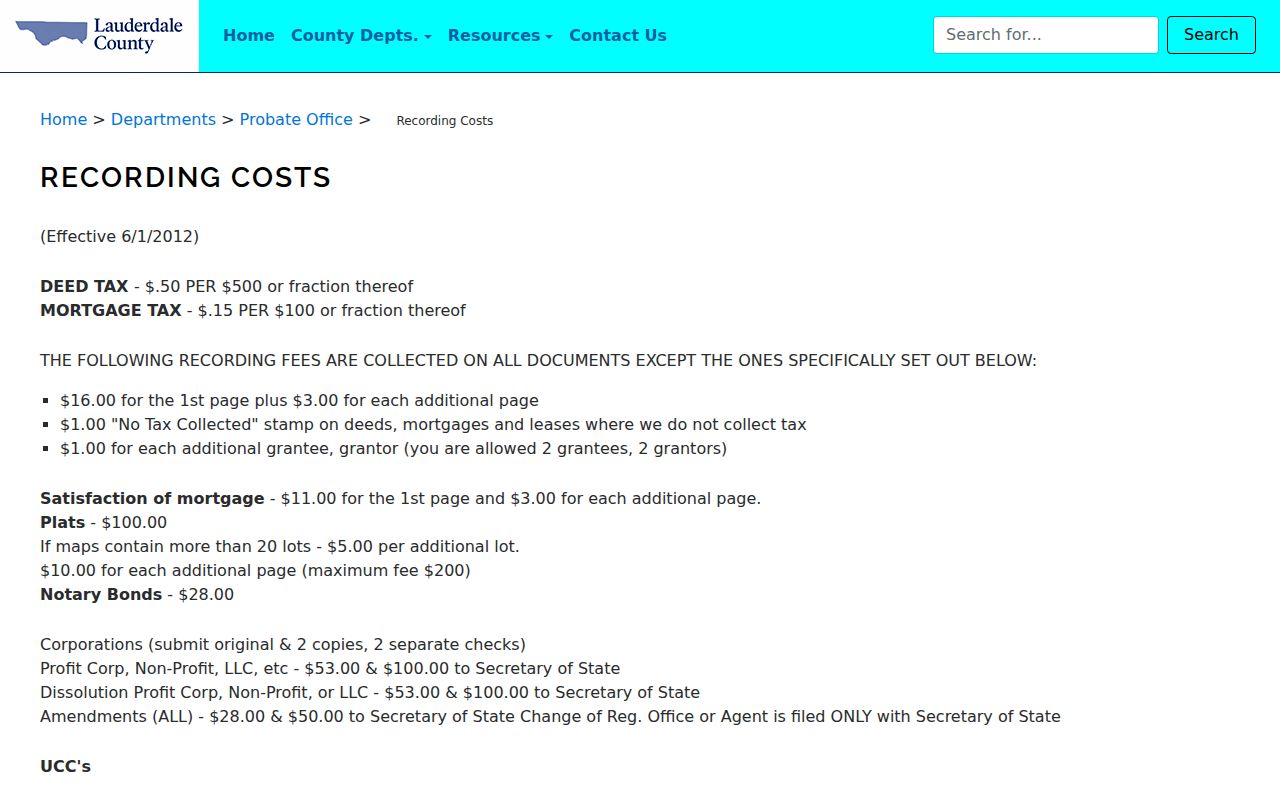
Check the live page before mailing funds because its headings include older effective-date labels.
Trace Lauderdale Grantors Backward
A grantor conveys an interest in land. The grantee receives it. The grantor-grantee index ties both names to their recorded instruments, and a chain of title is simply the sequence of transfers affecting the same tract. Book and page mark a spot in recorded volumes, while an instrument number is a separate filing identifier.
- Locate the latest verified deed for the parcel.
- Record the grantee, grantor, date, type, and reference.
- Search that grantor as a grantee in an earlier period.
- Match the legal description before accepting the link.
- Repeat to the required time depth.
Names alone are weak connectors. One party may own several tracts. Entity names can shift too, so preserve AKA, FKA, KNA, and WTTA variants exactly across Lauderdale County records, then compare lot, block, subdivision, acreage, section-township-range, dimensions, and plat references.
Chain terms: a reverse index flips the party direction. Book/page and instrument numbers locate a filing, but only a matched legal description connects the same land in Lauderdale County records.
Lauderdale Legal Clues Outlast Addresses
Street names and parcel numbers can change. Legal clues persist. One Florence record points to City of Florence Block 75, PB 2 PG 155, fixed dimensions, and a beginning call near Tennessee and Court Streets. A second styles the same land as Block 0075, block 75P, subdivision code 2073, section-township-range 10-03S-11W.
Official 2023 county minutes identify Belle Meade Addition No. 1 at Map Book 3, Page 166. The action vacated a Dalewood Street alley. A later public action can shift street context while the older plat stays in the deed trail of Lauderdale County property records. Search both.
Note: A legal description identifies land through record language; it does not replace a field survey.
Validate Every Lauderdale Deed
Lauderdale County's recording checklist requires a completed, signed, dated Real Estate Sales Validation Form with every deed, under Alabama Code §40-22-1. The form wants the purchase price or today's value. A recordable submission also needs the preparer's name and address, proper notarization with its expiration, legible exhibits in correct order, and a return person or company. Probate requires originals. Copies will not do, and filers should not highlight documents. A mailed package needs correct payment and a self-addressed stamped envelope. A correction filing should say what it corrects. A release should supply the relevant book and page.
Check Lauderdale Recording Costs
The posted Lauderdale County schedule sets deed tax at $0.50 per $500 or fraction. General recording runs $16 for the first page plus $3 per added page. The no-tax stamp is $1. Each indexed party beyond the two allowed adds $1. Plats start at $100. Added lot and page charges cap at $200. Certified copies are posted at $3 for certification plus $1 per page, and mortgage, satisfaction, miscellaneous-instrument, and UCC charges follow other formulas. Because the page carries older date references, estimate first, then confirm the current total with Recording before sending payment.
Follow Lauderdale Encumbrance Records
A deed is only part of the recording trail. Mortgages, satisfactions, assignments, amendments, subordination agreements, partial releases, and financing statements all leave their own entries in Lauderdale County real estate records. Search those instrument types under the current owner and each prior owner. Then match every hit by land description and sequence. Skip them and the picture stays incomplete.
A satisfaction belongs to the mortgage it retires. The county checklist requests book and page on releases, so preserve those references on the first pass through the deed records. A UCC filing can matter once it is cross-indexed in real estate. It is not a deed, though.
Title disputes also live in the courthouse. The Lauderdale Circuit Clerk keeps circuit and district court files covering foreclosure, quiet title, partition, and judgment actions. Alabama's paid Just One Look system carries much of the trial record. The courthouse counter remains another access route. A court filing can explain the deed trail without being the conveyance itself.
Connect Lauderdale Estate Transfers
Probate case records can hold wills, inventories, administration papers, orders, and estate deeds. An heir named in a will does not become the owner of record automatically. Trace the estate authority and any resulting deed into the land-record index. Compare the newest deed with the tax roll.
A focused probate request names the decedent, case type, case number if known, filing range, and the exact document sought. Give the decedent and the case type first. Add the case number if known. Include the filing range and the exact document sought. The Probate office lists 256-760-5804 for court matters. Death certificates follow separate Alabama Department of Public Health rules. Restricted periods and identity requirements are attached.
The county-linked land-record service is the online starting point. Its Lauderdale Probate landing screen opens that workflow.
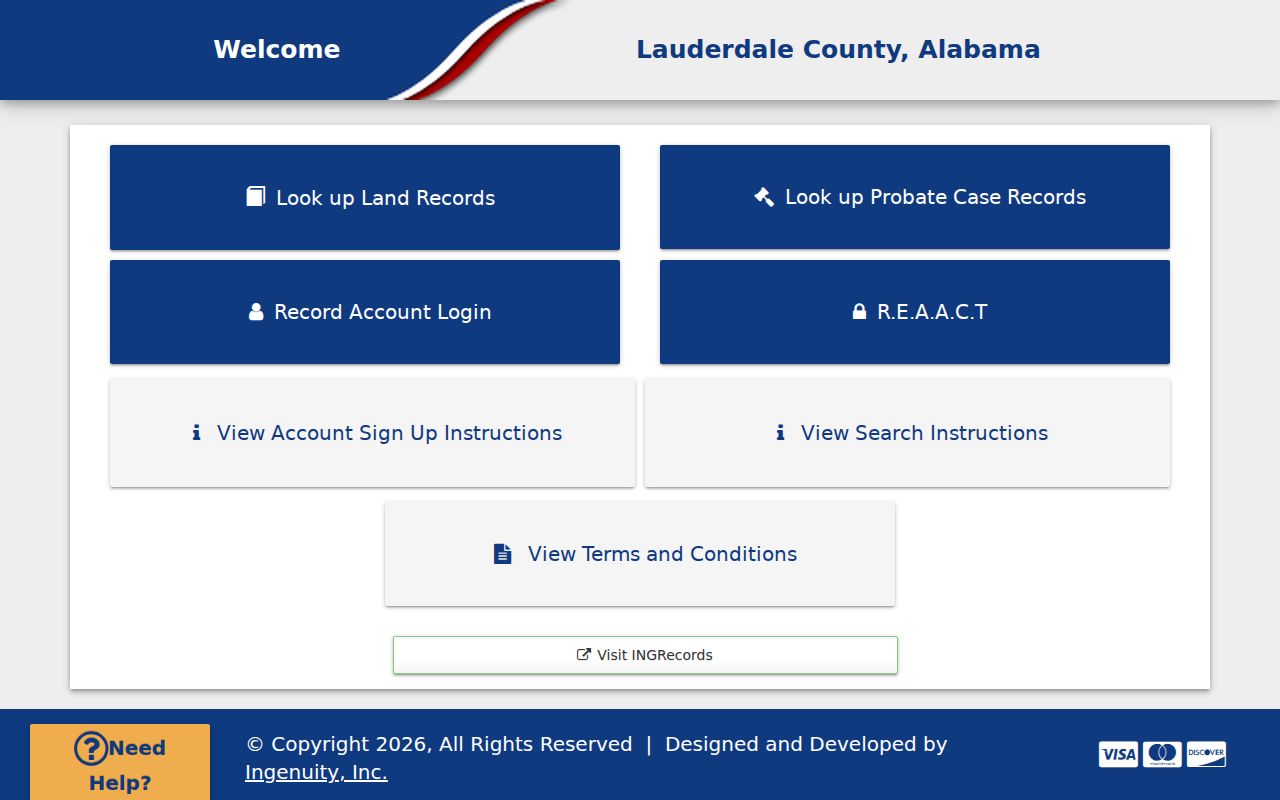
That landing screen is not a deed result. Use it to enter the authorized workflow. Then preserve the result reference and obtain the actual instrument.
Estate transfers leave gaps when only the decedent is searched. An administrator, executor, personal representative, trust, or court order may sit behind the transaction instead. Search the case file and recording index in tandem. Use the same parcel description in both. The tax roll may still name the decedent or the estate. The newest deed plus the case authority tell you what actually happened.
Separate Deeds From Tax Owners
The DCS assessment portal returns an owner label, PPIN, parcel details, a prior deed reference, and a legal description. It is a good way to locate the tract. The portal shows a tax roll update of August 19, 2023 and publishes no standard refresh cycle. A newer deed can outrun the listed owner.
Recorded, not guaranteed. Recording gives public notice, but an index hit does not prove validity, resolve every claim, or provide a title opinion.
Let the tax card locate the tract. Confirm the transfer only through the newest recorded instrument, and let a title professional or attorney weigh the full chain and encumbrance record.
Older Lauderdale Deeds Cross Custody
Older Lauderdale County deeds cross custody lines. The Alabama Secretary of State Lands Division holds state land records from statehood through 1950. Later county transactions go to the Probate Judge. A long chain can climb into older county books. It may end at a state grant or patent.
The Alabama Historical Commission method advises starting with the latest grantor. From there you follow deed references backward. Florence-Lauderdale Public Library and the Alabama Department of Archives and History add maps, microfilm, and local context. They aid interpretation but never replace the official deed record.
Request Lauderdale Deed Copies
Give Recording the instrument type, grantor, and grantee. Add the date range, book/page or instrument number, and the parcel or legal description. Say whether a plain or a certified copy is needed. Call 256-760-5800 to confirm availability, cost, and payment before mailing.
Online users should save permitted images through the vendor's controls. Purchased documents remain in My Documents for 30 days. Online coverage can stop short of the deed you need. The counter, phone, and mail routes still matter. Historic work can move on to the library, the archives, or the state land portal. Official county deed records stay anchored in Probate.
Explain why the document matches the parcel. The situs is only a lead. Add the full legal description, PPIN, parcel number, and any prior book/page citation you have. Ask staff to separate an index printout from the recorded image. Ask them to separate a plain copy from a certified one. If an exhibit is unreadable, name the exact page or attachment. The same goes for a missing page.
File the returned deed with its source, certification status, and request date. Transcribe names exactly, initials and entity suffixes included. Update the chain table next. Record the new grantor, grantee, recording date, and description. That discipline matters. It keeps a similarly named party or a neighboring lot from quietly entering the chain.